Week 5 - Wednesday, February 25th
Class Goals (for Students and Professor)
- Review reading academic research, and applying terms of reliability and validity.
- Use the language of R, statistics, and our human brains to understand data.
- Professor not rushing; students all learning; we all enriched and nourished by knowledge of research methods.
Class Slides
Useful Links
- Check-In : tinyurl.com/peeppeople
- Article on fMRI for the check-in
- REMINDER : I chose this article in part because I don’t understand everything. It is okay for you to not understand everything!
- R Activity Document.Wait to download this, please! Clicking the link will automatically download a file to your computer.
- Class Page + Vision Board
Agenda and Announcements
Agenda :
- 25 Min : Part 1 : Check-In Review (Reading research and reliability and validity in fMRI)
- 50 Min : Part 2 : Data Analysis in R
- 5 Min : Recap & Next Week (Whew.)
Announcements :
Next Week : On Measurement and Observations!
Pausing Work on Dig Deeper : Will return to this in a few weeks (the compare/contrast essay) as a review. Gave Discussion 2 feedback on topic.
Office Hours in SSSC from 2:00 - 4:00. Supposedly a lot of high-school students coming at 3:00 PM to talk to me as a requirement for their enrollment in Psych C1000 today.
Due Next Week before Class
- Read the articles below. Optional readings are not required; but let me know if you read and have thoughts!
- Complete Discussion 5. Questions below, submit on Canvas and sometimes the Vision Board.
- Complete Reading Quiz 5. on Canvas.
Readings for Next Week (and Quiz 5)
Read my brief overview on Measures. Focus on the different strengths and limitations of self-reports and observational methods. We will focus on observational methods next week, but it might be helpful to have some background on self-report methods to help differentiate the strengths & limitations.
Read this chapter on Observational Research. You can skim much of this, but focus on the different types of observational studies.
Read through the chapter on the Specific Affect Coding System (SPAFF). This is an example of a guide for researchers interested in making observations of emotion. Focus on the “three rules” of people watching, and the different guidelines for behavioral coding (e.g., function, indicator, cues, counter-indicators). You can skim the stuff on “Action Units” in the face, though note this is an example of how psychologists have tried to quantify emotion with numbers like “REAL SCIENTISTS”.
OPTIONAL READINGS : Not required, but for students who would like to learn more. Let me know if you have questions.
A blog post summarizing the dead fish study we read in class. Some fun history too, like how the fish was purchased.
Gottman (author of the SPAFF Coding Guide) ran a series of very influential couple studies; here’s a behind the scenes video of some of the methods they use to measure how couples fight.
Week 5 Discussion Questions.
YOUR POST : Use the readings to answer the following questions. Please submit answers to the graded Canvas discussion post to help me keep track of your work, but when prompted please also copy / paste your work to our Vision Board so we can more easily see (and expand upon) this work together in class.
IN CLASS. Work with your buddy to choose one variable from our reading survey. Graph this variable and try to make the graph look nice, report the mean, median, standard deviation, and range of this variable, and then explain what these statistics mean (what do we learn about the people in the data?) (Note : if you missed class, watch the recording and try to follow along. If you get stuck in R, use one of the student-generated examples from the Vision Board - Week 5 - as a guide! You DO NOT NEED to do any R on your own! Just want to see you are trying to think about data. We will continue reviewing this skill.)
From the Chapter on Measures. Answer the final question in the reading (
"If you look like you are smiling and have the neurotransmitter levels that suggest you are happy and our $600/hour test says that your brain is activated in a way consistent with happiness, but you FEEL and SAY you are miserable....are you happy?") Why did you choose this answer?From the SPAFF Reading (On the Vision Board, Week 6). Try using the “three rules” of people watching to observe someone. Describe who you chose to observe. Then, describe a specific way that each of the three rules informed your observations of the person (what insights did you learn or gain)? I’ve posted an example of this in the Vision Board (and the required reply below.)
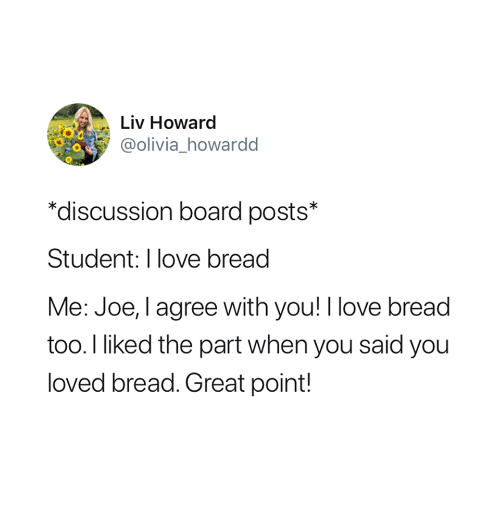
We Love Bread (REPLY TO ANOTHER STUDENT). Look over another student’s post on the Vision Board for Question 3. What is one variable that you would label for their observation? Then, think about how this variable might be measured with a self-report. Give an example of how this variable might be high or low in either a) self-insight OR b) self-diminishment/enhancement. Reply on the vision board, but also paste your response here to help me keep track of the grading.