Hi Class, It is Week 3
- Check-In Here : tinyurl.com/readingread

Agenda and Announcements
Agenda :
- 10 Min : Welcome and Check-In
- 20 Min : Part 1 : Cognitive Biases in Real-Life and Science
- 40 Min : Part 2 : Academic Articles
- 15 Min : Part 3 : We only have <15 minutes to Read an Article????
Announcements :
How’s the class going?
Comments / Concerns / Complaints / Compliments?
Posting to Canvas & the Vision Board?
Office Hours in SSSC (LC-105) Today. 2:00 - 4:00.
Week 2 Vision Board Review
Models & Me-Search
The Dig Deeper Assignment
Part 1 : People (and Scientists) Are Biased
ACTIVITY : Identifying Biases in Horoscopes
Find examples of each of the different cognitive biases: Patterns in Randomness, Positive Evidence, Previous Beliefs, Availability, Social Influence, Regression to the Mean.
DISCUSSION : Biases in Science
- How might the scientific method PREVENT these biases?
- How might the scientific method PROMOTE these biases?
- Patterns in Randomness
- Positive Evidence
- Previous Beliefs
- Availability
- Social Influence
- Regression to the Mean.
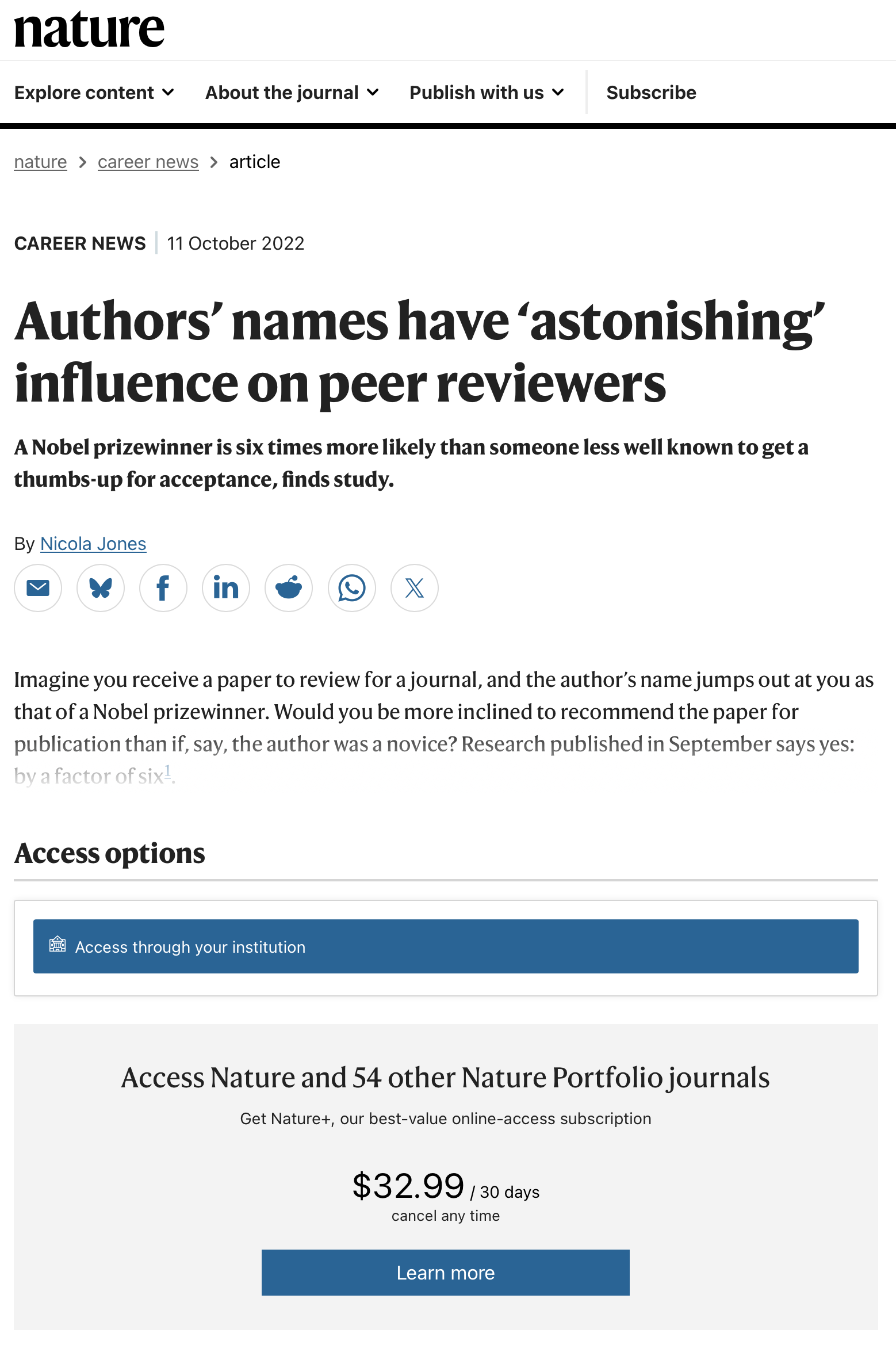
EXAMPLE : biases in peer-review?
Part 2 : Scientific Business
RECAP : questions?
The People Involved:
author : the person(s) who writes the article
affiliations : where the authors come from
editor : a person who sends the article to review, and ultimately decides whether to accept / reject an article for publication.
peer reviewers : other scientists who comment on the article and give feedback before it is published (unpaid, anonymous, and uncredited on the paper)
Types of Scientific Articles
original report : one or more studies where researchers collect original data to answer a specific question(s)
replication : a copy of a previous original report (with new people)
literature review : summarizes main ideas from past research to find common themes
meta-analysis : summarizes data from past studies to find common themes.
Ways To Evaluate an Article :
citation count : the number of times that other people reference a specific article.
impact factor : the average number of times the average article in a journal has been cited in an average year
jargon : the specific words psychologists use to define variables.
APA Citation (or “Citation in APA Format”) : a super specific way of referencing an article that you do NOT need to memorize because computers do this for us.
ACTIVITY : VISION BOARD.
INSTRUCTIONS
- Open the Vision Board.
- Find the final project tab; copy your model from Week 2.
- Copy my annotated bibliography template.
- Find some articles
GOAL : Learn more about the topic than you did before
- look to the present : what do you learn from this article?
- look to the past : what reserach was cited by this article?
- look to the future : what articles have cited this article?
PART 3 : READING AN ARTICLE

WE DON’T HAVE TIME TO READ, PROFESSOR!
- How are you feeling as you look at this document?
- Abstract –> Headers –> What looks interesting?
NEXT WEEK : WE HAD TIME TO READ, PROFESSOR!
Continue your literature review. Cool!
Do a closer reading of the “Objectivity Interrogation” article. Okay not to understand everything; we will discuss!
Learn about reliability and validity and why phrenology was hella racist bad science.
Byeeeeee.
