mod2 <-lm(Handwash ~ CONSC, data = d)summary(mod2)
Call:
lm(formula = Handwash ~ CONSC, data = d)

Residuals:
    Min      1Q  Median      3Q     Max
-3.4263 -0.4142  0.5677  0.5919  0.6039

Coefficients:
            Estimate Std. Error t value Pr(>|t|)
(Intercept)  3.46854    0.14382  24.117   <2e-16 ***
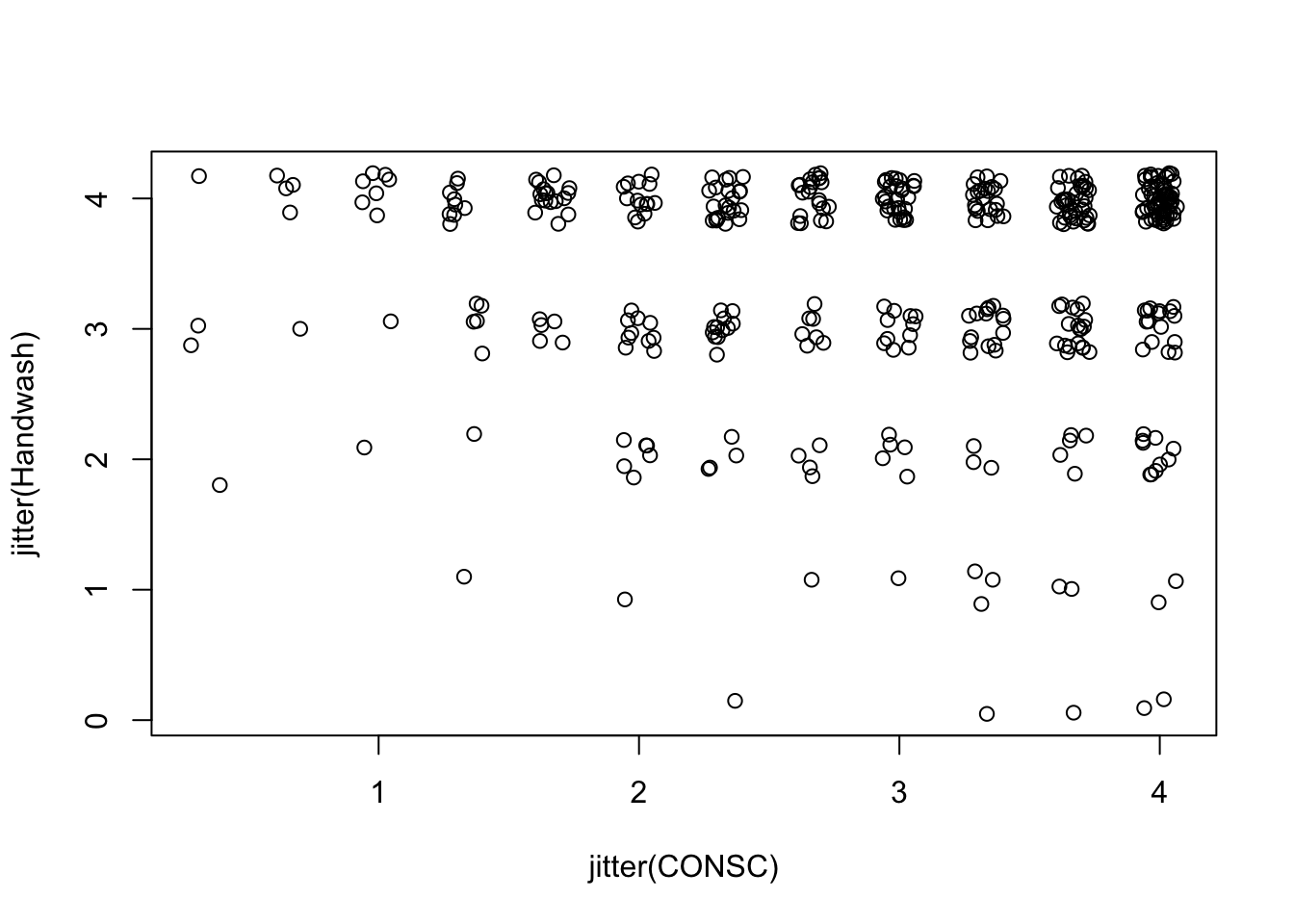
CONSC       -0.01812    0.04628  -0.392    0.696
---
Signif. codes:  0 '***' 0.001 '**' 0.01 '*' 0.05 '.' 0.1 ' ' 1

Residual standard error: 0.8688 on 403 degrees of freedom
  (437 observations deleted due to missingness)
Multiple R-squared:  0.0003804, Adjusted R-squared:  -0.0021
F-statistic: 0.1534 on 1 and 403 DF,  p-value: 0.6956
plot(jitter(Handwash) ~jitter(CONSC), data = d)
mod3 <-lm(Handwash ~ political_party, data = d)summary(mod3)
Call:
lm(formula = Handwash ~ political_party, data = d)

Residuals:
    Min      1Q  Median      3Q     Max
-3.2770 -0.5677  0.4323  0.7230  0.7230

Coefficients:
                 Estimate Std. Error t value Pr(>|t|)
(Intercept)       3.56771    0.06183   57.70  < 2e-16 ***
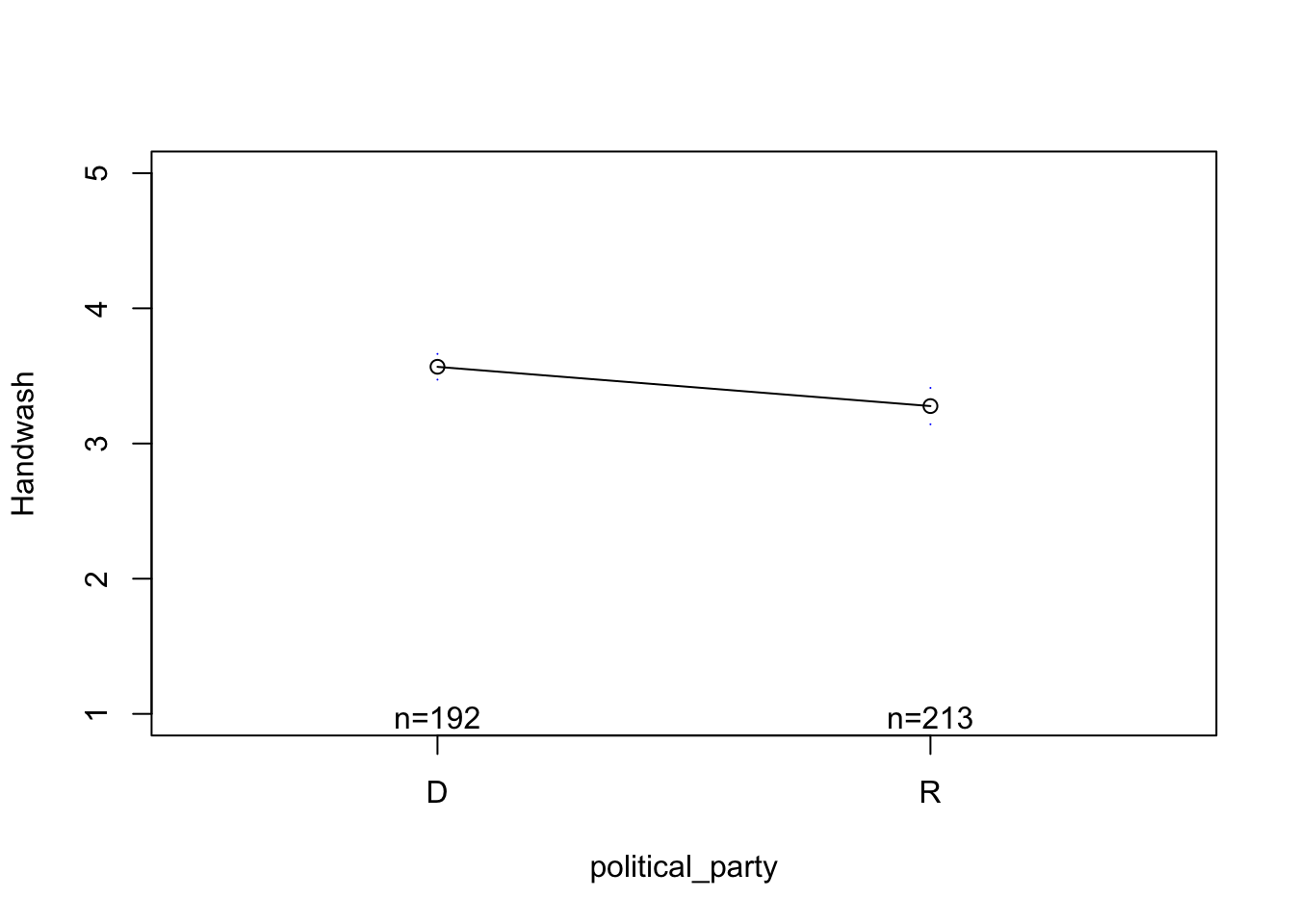
political_partyR -0.29071    0.08525   -3.41 0.000715 ***
---
Signif. codes:  0 '***' 0.001 '**' 0.01 '*' 0.05 '.' 0.1 ' ' 1

Residual standard error: 0.8567 on 403 degrees of freedom
  (437 observations deleted due to missingness)
Multiple R-squared:  0.02804,   Adjusted R-squared:  0.02563
F-statistic: 11.63 on 1 and 403 DF,  p-value: 0.0007153
plotmeans(Handwash ~ political_party, data = d, ylim =c(1,5))
Warning in arrows(x, li, x, pmax(y - gap, li), col = barcol, lwd = lwd, :
zero-length arrow is of indeterminate angle and so skipped
Warning in arrows(x, li, x, pmax(y - gap, li), col = barcol, lwd = lwd, :
zero-length arrow is of indeterminate angle and so skipped
Warning in arrows(x, ui, x, pmin(y + gap, ui), col = barcol, lwd = lwd, :
zero-length arrow is of indeterminate angle and so skipped
Warning in arrows(x, ui, x, pmin(y + gap, ui), col = barcol, lwd = lwd, :
zero-length arrow is of indeterminate angle and so skipped
Some Pre-Recorded NHST Review Videos
Note : I used last semester’s dataset for these examples, so you will likely get different results if you try and replicate in this semester’s class; a good example of how NHST doesn’t really tell us whether the results are “truth” or not, or whether they will replicate, etc.
moda <-lm(height ~ long.hair, data = d)summary(moda)
Call:
lm(formula = height ~ long.hair, data = d)

Residuals:
     Min       1Q   Median       3Q      Max
-13.1660  -2.5734  -0.5734   2.4266  10.4266

Coefficients:
             Estimate Std. Error t value Pr(>|t|)
(Intercept)   66.1660     0.5187 127.568  < 2e-16 ***
long.hairYes  -1.5927     0.6108  -2.607  0.00985 **
---
Signif. codes:  0 '***' 0.001 '**' 0.01 '*' 0.05 '.' 0.1 ' ' 1

Residual standard error: 3.776 on 188 degrees of freedom
  (9 observations deleted due to missingness)
Multiple R-squared:  0.0349,    Adjusted R-squared:  0.02977
F-statistic: 6.799 on 1 and 188 DF,  p-value: 0.009854
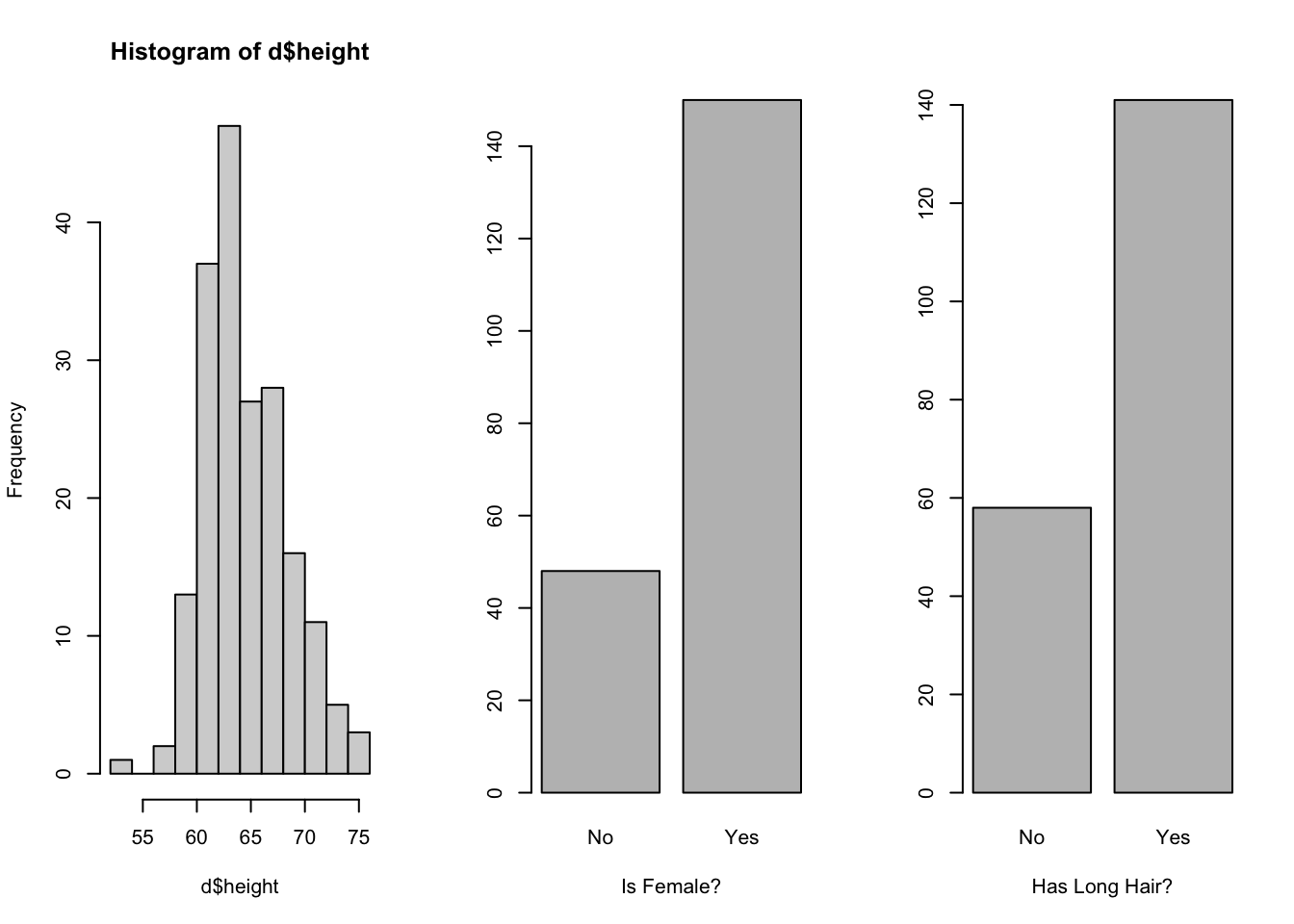
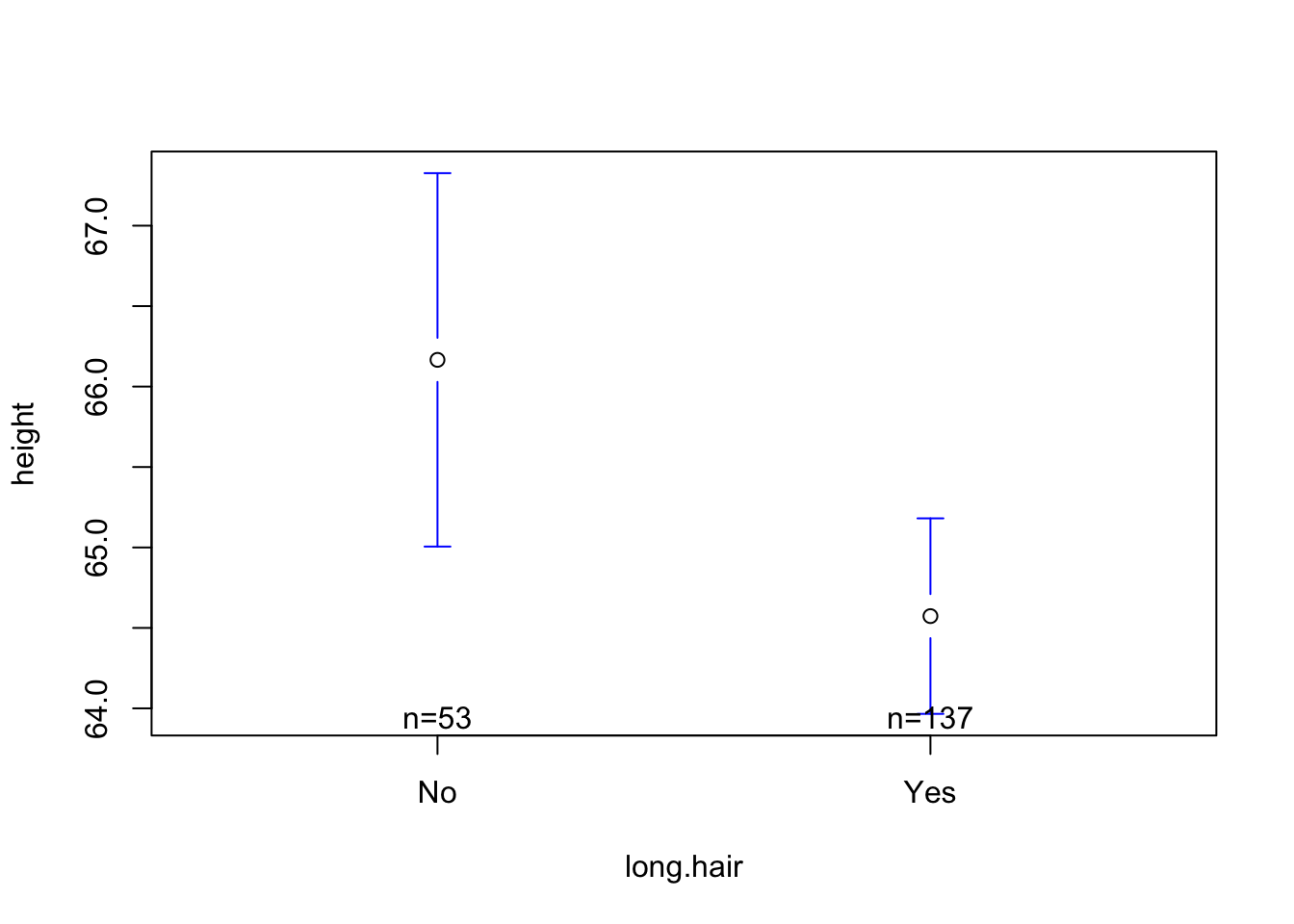
plotmeans(height ~ long.hair, data = d, connect = F)
modb <-lm(height ~ is.female, data = d)summary(modb)
Call:
lm(formula = height ~ is.female, data = d)

Residuals:
    Min      1Q  Median      3Q     Max
-10.958  -1.958  -0.487   2.042   9.042

Coefficients:
             Estimate Std. Error t value Pr(>|t|)
(Intercept)   68.4870     0.4821 142.074  < 2e-16 ***
is.femaleYes  -4.5293     0.5542  -8.173 4.44e-14 ***
---
Signif. codes:  0 '***' 0.001 '**' 0.01 '*' 0.05 '.' 0.1 ' ' 1

Residual standard error: 3.269 on 187 degrees of freedom
  (10 observations deleted due to missingness)
Multiple R-squared:  0.2632,    Adjusted R-squared:  0.2592
F-statistic: 66.79 on 1 and 187 DF,  p-value: 4.438e-14
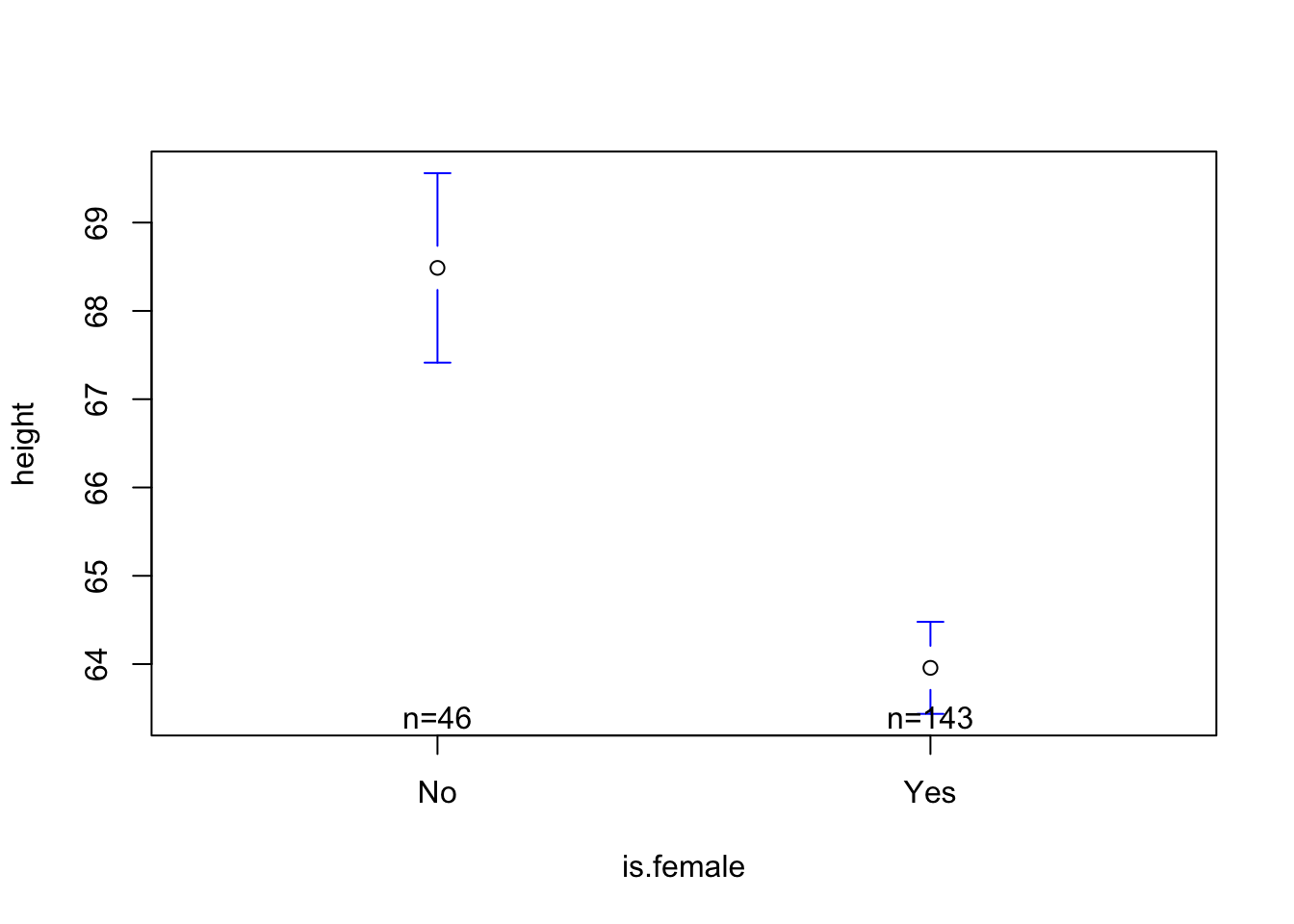
plotmeans(height ~ is.female, data = d, connect = F)
modc <-lm(height ~ long.hair + is.female, data = d)## NO GRAPH FOR THE MULTIPLE REGRESSIONsummary(modc)
Call:
lm(formula = height ~ long.hair + is.female, data = d)

Residuals:
    Min      1Q  Median      3Q     Max
-10.097  -2.106  -0.180   1.894   8.894

Coefficients:
             Estimate Std. Error t value Pr(>|t|)
(Intercept)   68.1800     0.5156 132.239  < 2e-16 ***
long.hairYes   1.0086     0.6190   1.630    0.105
is.femaleYes  -5.0828     0.6479  -7.845  3.3e-13 ***
---
Signif. codes:  0 '***' 0.001 '**' 0.01 '*' 0.05 '.' 0.1 ' ' 1

Residual standard error: 3.255 on 186 degrees of freedom
  (10 observations deleted due to missingness)
Multiple R-squared:  0.2736,    Adjusted R-squared:  0.2657
F-statistic: 35.02 on 2 and 186 DF,  p-value: 1.235e-13
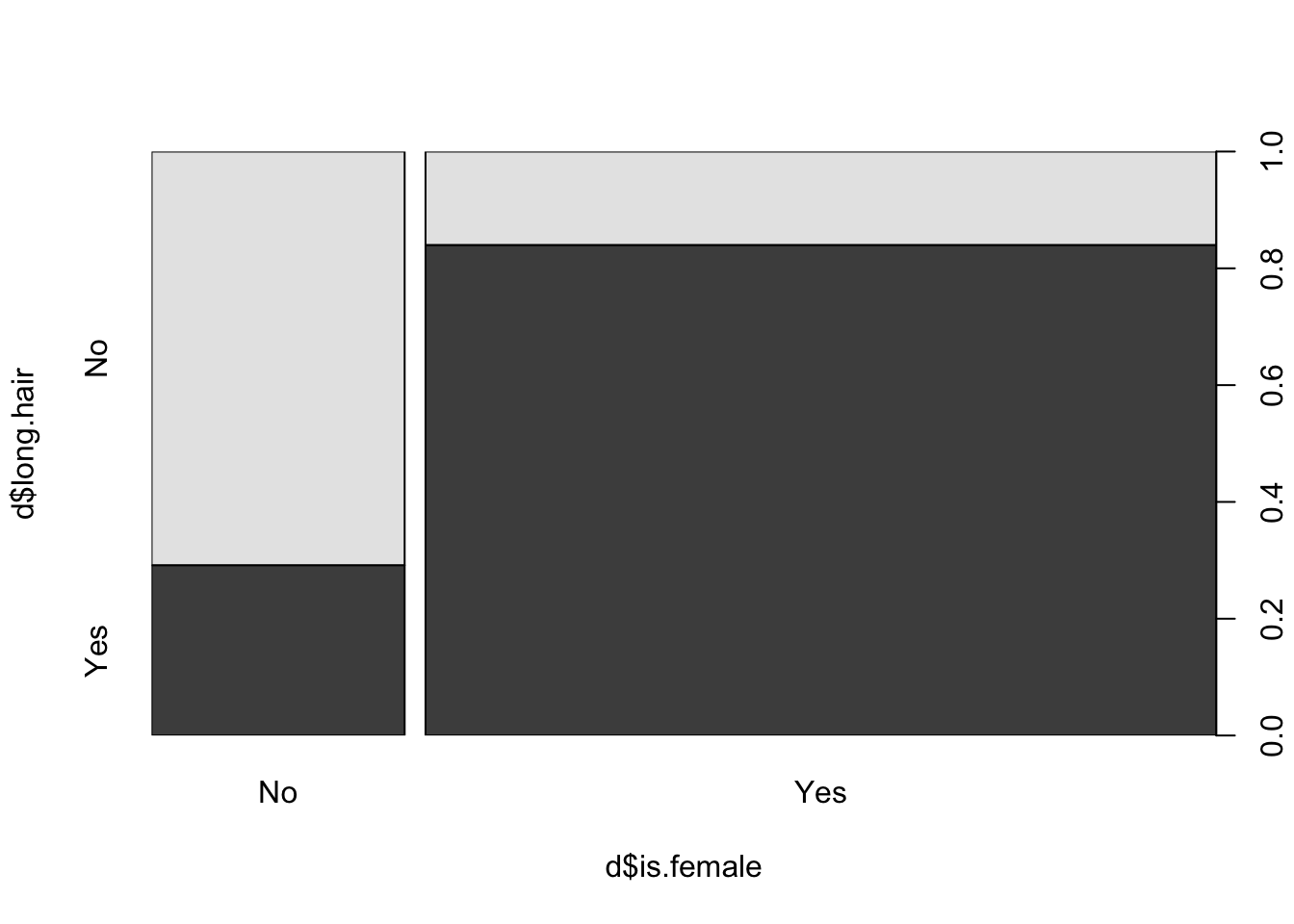
IV1 and IV2 are related to each other, and each related to the DV)
plot(d$long.hair ~ d$is.female)
Multiple Regression : Visualized in Multi-Dimensional Space!
The code below may not work on your computer; see lecture recording for an interpretation / explanation!
#install.packages('rgl')#install.packages('car')library(car)library(rgl)scatter3d(as.numeric(d$is.female), # IV1 - must be numeric (if not already) d$height, # DVas.numeric(d$long.hair)) # IV2 - must be numeric (if not already)
Reporting Effects in a Regression Table.
Table 1. Unstandardized Regression Coefficients; Predicting Height from Long.Hair and Is.Female.
Model 1
Model 2
Model 3
Intercept
Long.Hair (0 = No; 1 = Yes)
Is.Female (0 = No; 1 = Yes)
\(R^2\)
There’s a Package in R For This!
# install.packages("jtools") # a new package!!!library(jtools) # make sure you installed the new package first.export_summs(moda, modb, modc,coefs =c("Long Hair (0 = No, 1 = Yes)"="long.hairYes","Is Female (0 = No, 1 = Yes)"="is.femaleYes"))
Model 1
Model 2
Model 3
Long Hair (0 = No, 1 = Yes)
-1.59 **
1.01
(0.61)
(0.62)
Is Female (0 = No, 1 = Yes)
-4.53 ***
-5.08 ***
(0.55)
(0.65)
N
190
189
189
R2
0.03
0.26
0.27
*** p < 0.001; ** p < 0.01; * p < 0.05.
BREAK TIME : MEET BACK AT 4:40
Milestone #4 : Anyone want to share their project?